@ahmetcantryk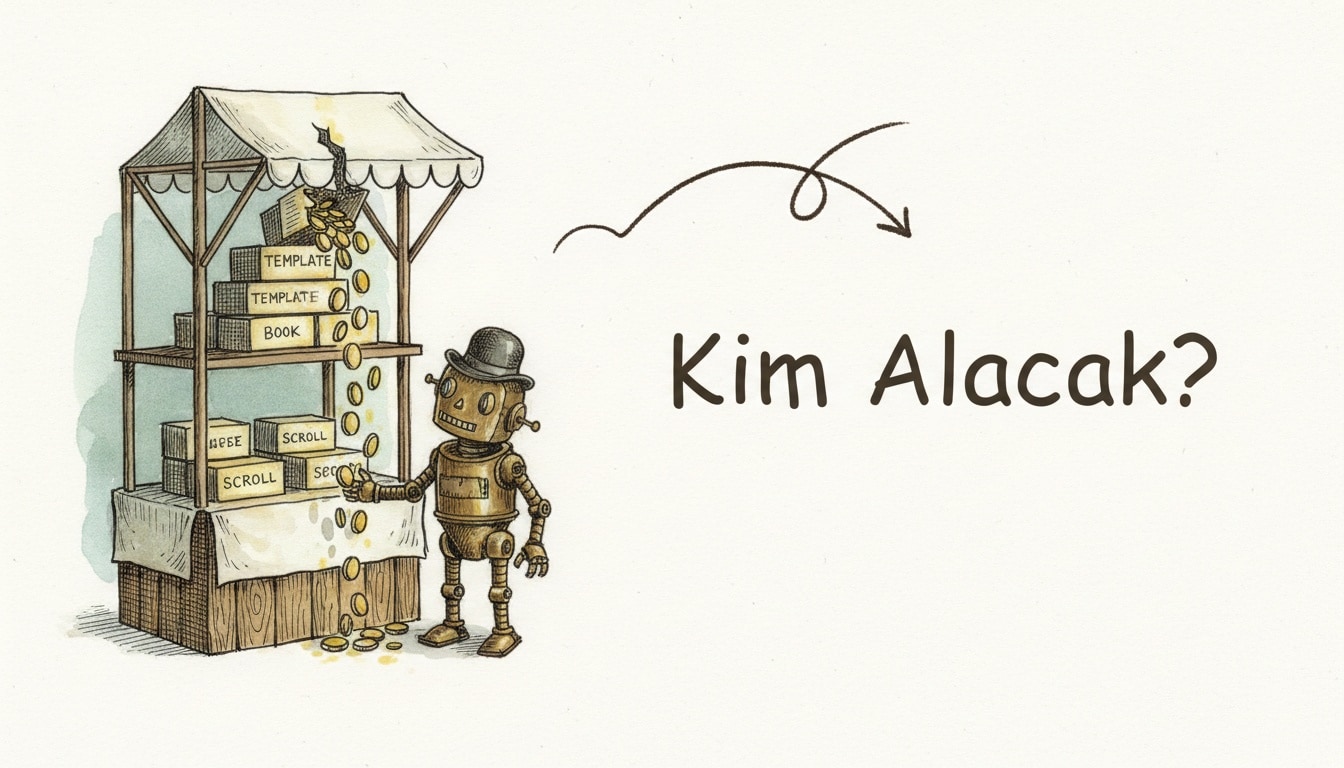
Selling digital products remains one of the most realistic solo income models in 2026: build something once — a template, a Notion system, a mini-course — and sell it repeatedly. AI has made the production side nearly free, so the real question isn't "how do I make this" anymore, it's "who buys it, and how do they find it." This guide walks the whole chain: what actually sells, validating demand before you build, pricing and platform choice, and why distribution is still the real bottleneck.
What actually sells?
The digital-products category is broad, but a handful of patterns account for most of the money. Templates (Notion, Figma, spreadsheets), systems that solve one specific job (a content calendar, a finance tracker, a CRM skeleton), prompt packs, ebooks, and short mini-courses are the most repeated formats. What they share is a narrow, concrete problem — not generic "productivity," but something specific like "a client-approval workflow for freelance designers."
2026 Gumroad platform data confirms this pattern. Gumroad's 2026 state-of-the-platform report tracked $206 million in total revenue across 146,271 products, with software development the highest-earning category at an average $60,814 per product. But the same report reveals the harder truth: 99.5% of all platform revenue goes to the top 1% of creators, and the median creator earns just $72 a month. Even with the right product idea, revenue stays near zero without distribution.
Validating demand before you build
Since AI made production cheap, the biggest risk shifted to "perfecting something nobody wants." Validation works in three steps, done before the product is finished: open a waitlist or pre-sale page to collect real email or payment intent; ask the question directly inside a community your audience already lives in (a Discord, a subreddit, a LinkedIn group); and try a "concierge MVP" — deliver the outcome manually to a few people before automating it, and see whether they genuinely find it valuable. A product built before demand is validated rarely makes up for it in sales numbers, no matter how well it's executed.
Producing and packaging fast with AI
Production is the part that's genuinely sped up. You can draft a Notion system or template skeleton with AI in a few hours, produce a first draft of an ebook in conversational language and edit it into your own voice, or script and slide a mini-course with AI-assisted tools. The critical part is that AI accelerates the skeleton, but the final polish — real examples, details from your own experience — needs to be added by hand, or the product reads as generic and gets lost among hundreds of similar ones. Our guide on AI-powered content marketing for small teams covers the same production workflow in more depth, and the same principles apply when producing marketing material for your own product.
Pricing and platform choice
Three platforms dominate this space, each serving a different audience.
Platform | Strength | Best product type |
|---|---|---|
Gumroad | Low friction, fast setup, developer/creator audience | Templates, prompt packs, code-based products |
Lemon Squeezy | Automated tax/VAT handling, SaaS-adjacent infrastructure | Digital tools, licensed software, subscription models |
Etsy | Massive built-in shopping traffic, strong discovery engine | Planners, design templates, visual products |
The most common pricing mistake is underpricing — a low price signals low perceived value and raises support load. The $15–49 range is a reasonable starting point for most templates and systems; a mini-course or a comprehensive system can go to $99–299. Price against the value of the problem solved, not the time it took to produce.
Distribution is the real bottleneck
The power law visible in Gumroad's data isn't a coincidence — the platform itself is payment infrastructure, not a discovery engine. You have to bring the traffic. The most sustainable path is building a newsletter and a social presence; our guide on growing and monetizing a newsletter in 2026 walks through building an email list from zero, and that list becomes the asset you can resell against at zero marginal cost with every new launch. On the social side, sharing the build process openly builds trust and naturally creates a pre-launch waitlist.
Keeping the support load small
As your product count grows, the biggest time sink isn't making new products — it's answering existing customers' questions. The most effective fix is adding an FAQ section and a short walkthrough video directly to the product itself; most support requests exist because the bundled documentation wasn't clear enough. The second fix is turning repeated questions into an AI-assisted reply template, so you personalize and send instead of writing each answer from scratch. The third is setting a clear update cadence — monthly rather than weekly — and telling customers about it upfront, which heads off a steady stream of "when's the next update" messages.
The honest ceiling of "passive"
To be honest: no digital product is truly passive. Answering customer questions, keeping the product current, adapting to new platform rules, and continuously driving new traffic never stops. The real win is moving from selling hours to selling an asset — you build it once and sell it hundreds of times — but that isn't zero maintenance. Even the most successful creators spend a few hours a week on support and marketing; "passive" here means "not paid by the hour," not "no effort at all."
My honest take: the biggest misconception in this space is that AI making production cheaper automatically guarantees revenue. In reality, AI cheapened the competition too — everyone can ship a similar product at the same speed — so the actual differentiator isn't the product anymore, it's who sells it and to which trusted audience.
For the tool stack that keeps this process sustainable for solo builders, see our post on the 2026 AI stack for solopreneurs, and for real maker stories following a similar path, see Micro-SaaS with AI: real maker stories.
First-product launch checklist
- Pick a narrow, concrete problem, not a generic category.
- Validate demand with a waitlist or pre-sale page.
- Produce fast with AI, but hand-polish the last 20% in your own voice.
- Choose the platform based on product type (Gumroad, Lemon Squeezy, or Etsy).
- Price against the problem solved, not the production time.
- Start building an email list or social following before launch.
- Plan a weekly support-and-update routine for the first 90 days.
Browse more solo business models in Business & Startups.
Frequently Asked Questions
How many followers do I need to start selling digital products?
There's no fixed threshold — even a small but relevant audience (a few hundred email subscribers) is enough to validate a first launch. What matters is whether that audience actually has the problem, not the follower count.
Which platform should I start with?
For a template or prompt pack, Gumroad is the lowest-friction option. For a subscription or licensed tool, Lemon Squeezy's tax automation simplifies your workload. For a visual-heavy planner or design product, Etsy's built-in shopping traffic is a real advantage.
How does an AI-produced product stand out from the rest?
Don't sell generic AI output as-is; hand-add real examples, corrections, and a distinctive point of view from your own experience. Buyers are actually buying your expertise and perspective, not the AI's first draft.
Is this model actually passive?
Not fully. It requires support, updates, and continuous marketing. The win is owning an asset you build once and sell repeatedly instead of billing by the hour — maintenance still continues, but revenue is no longer tied to production time.