@ahmetcantryk
If you run a three-person marketing team, your problem is not ideas — it is capacity. In 2026 the fix is not hiring more people; it is building a repeatable AI workflow. The data backs this up: 96% of content marketers now use AI tools, the highest adoption rate of any marketing role. But owning tools and owning a workflow are different things. The average team juggles more than 12 tools and spends 40% of its time managing them instead of creating content.
This guide walks through a practical, stage-by-stage AI content workflow that a small team can actually sustain: which tools earn their place at each step, why the human editor is non-negotiable, and what Google's stance on AI content actually says in 2026.
Why "scalable simplicity" wins

The biggest mistake small teams make is copying enterprise workflows. An ambitious system you cannot maintain is always worse than a simple one you can protect. The 2026 numbers confirm it: teams that use AI for research, outlining, and first drafts while keeping strategy, voice, and final editing human produce 34% more content at equal quality. Teams that adopt AI content tools publish 4.1x more content per person per month.
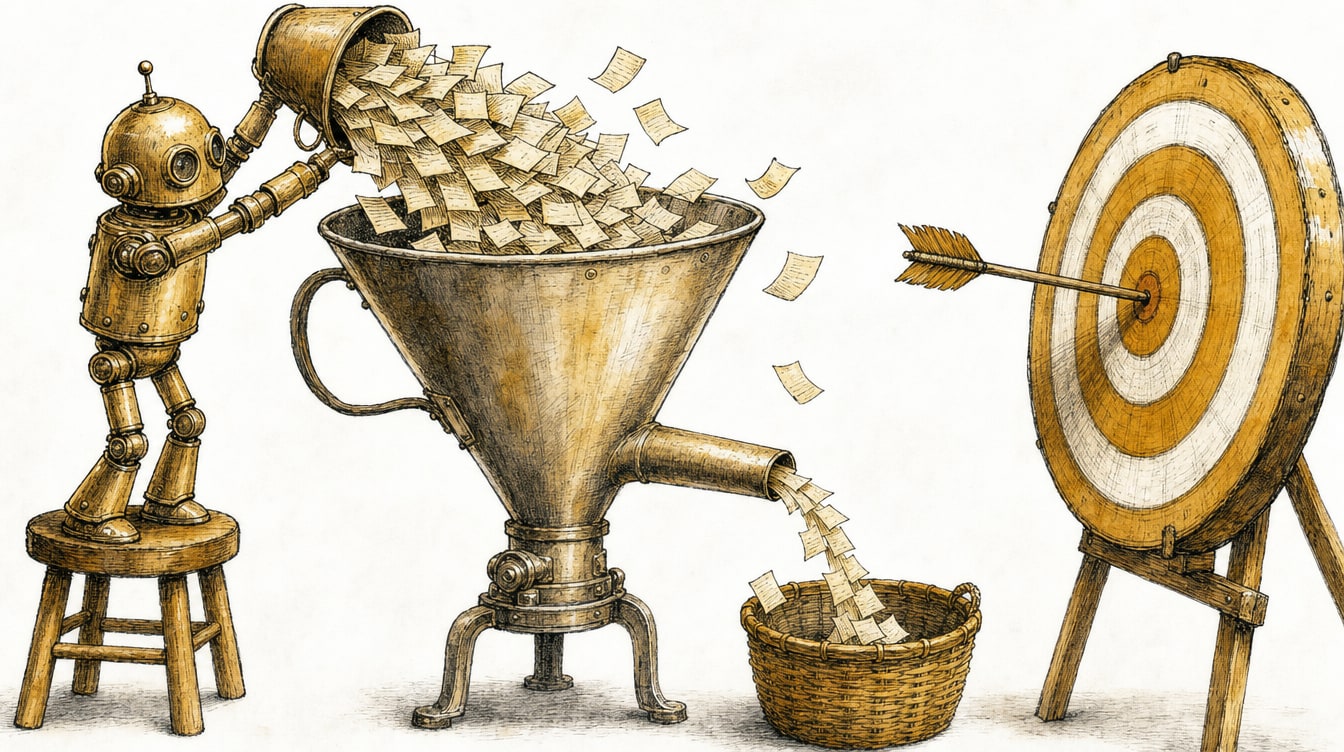
So the goal is not "let AI do everything." The goal is a production line that hands mechanical work to AI and judgment work to humans. Think of that line as five stages.
Stage 1: Intake and strategy
Every piece should start with an intake form that names the audience, the intent, and the search question it answers. Small teams routinely skip this step, and the result is content nobody can tell who it was written for.
Use AI here as a strategy partner: have it map the audience segment, the search intent, and the gaps in competing content. ChatGPT remains the default workhorse for this kind of research and ideation, and its paid tier at roughly $20 per month covers most small teams. Handing topic research and competitor analysis to AI can turn a full day of work into an hour — but verifying the output is your job, not the model's.
Stage 2: Drafting and structure
Once you have an approved outline, drafting becomes a production task. AI produces the first draft in minutes; the human editor makes it sound like your brand. The critical move is to never give AI a blank "write about this" prompt. Feed it the approved heading structure, voice notes, and a source list. The more structured the input, the more usable the output.
This is also where a two-model check pays off. Comparing drafts from two different LLMs and merging the stronger passages beats trusting a single model, and it helps you strip out the translated-sounding, "AI-smell" sentence patterns that erode trust. The editor's first job is to remove those patterns.
Stage 3: Visuals and multi-format
A small team's biggest advantage is producing text, images, video, and audio from the same core message. Even without a designer, you can generate cover images, social cards, and in-article graphics with AI visual tools. We compared the options in a dedicated guide: the best AI image generators in 2026 breaks them down by brand consistency and cost so you can choose deliberately.
The rule holds for visuals too: AI produces the draft, the human filters it against the brand guide. An inconsistent visual identity erodes trust faster than inconsistent copy.
Stage 4: Review and approval

Approvals are where small teams lose the most time, because feedback is subjective. The fix is a standard review step where every stakeholder uses the same checklist covering accuracy, voice, sourcing, and SEO basics.
Here is the data on why the human editor is not up for debate: in 2026, only 4% of content marketers trust raw AI output without human oversight. Human-edited AI pages show a 73% drop in bounce rate — proof that the editor is a multiplier, not a bottleneck. Teams that cut writers entirely show up in the 18% reporting quality declines and the 42% who abandoned AI initiatives.
The table below summarizes who does what at each stage:
Stage | AI's job | Human's job |
|---|---|---|
Intake and strategy | Audience, intent, gap analysis | Topic prioritization, decisions |
Drafting | First draft, structure options | Voice, accuracy, originality |
Visuals | Cover, card, graphic generation | Brand-consistency check |
Review | Grammar, SEO scan | Editorial sign-off, tone control |
Distribution | Format adaptation, scheduling | Channel strategy, community |
Stage 5: Distribution and repurposing
Publishing is half the work; the real leverage is in distribution. Turning one strong guide into a data page, a video script, and a set of targeted FAQ entries is far more efficient than producing each from scratch. AI saves serious time adapting content for social channels; if you want to build that flow in detail, our guide to using Claude for social media explains how to derive platform-specific posts while preserving tone.
If you want to see the whole tool stack, our roundup of the most popular AI tools in 2026 shows which tool leads in each category. The right stack usually looks like this: one or two LLMs doing the heavy lifting, a short list of specialty tools that genuinely earn their seat, an editorial layer that protects the brand, and a simple internal policy that settles the legal and ethical posture.
GEO: search is no longer just Google
The biggest shift of 2026 is that search has moved beyond Google. Google's AI Overviews now reach more than 2 billion monthly users, and ChatGPT serves 800 million people a week. Gartner predicted traditional search volume would fall 25% this year. That is why you now need to structure content not only for classic SEO but for Generative Engine Optimization (GEO) — that is, in a form AI engines can cite.
In practice that means clear definitions, FAQ blocks, step-by-step guides, and claims backed by statistics. Measurements show that adding quotes lifts AI visibility by 27.8%, adding statistics by 25.9%, and citing sources by 24.9%. Distributing content across multiple publications can raise AI citations by up to 325% compared with publishing only on your own site.
Does Google penalize AI content?
Short answer: no. Google does not penalize content for being AI-generated. What it targets is low-value, unoriginal content produced at scale to manipulate rankings — regardless of how it was made. Google's official guidance on AI content says it plainly: ranking systems reward original, high-quality content that demonstrates experience, expertise, authoritativeness, and trustworthiness (E-E-A-T).
The 2026 data supports this. AI-generated content now sits in top results, often right next to human-written content. The most common production model today is the "human-led, AI-assisted" workflow used by 64% of content marketers. In other words, the only thing Google cares about is whether the content is genuinely helpful and original — not the name of the tool that helped make it.
The minimum viable stack for a small team
Instead of trialing dozens of tools, collapse down to a four-layer minimum. First, one primary LLM for drafting and research. Second, one generator for visuals. Third, an organizational backbone for the content calendar and editorial workflow — a tool like Notion can serve as the single home for calendar, asset library, and documentation. Fourth, a half-page internal policy that spells out the legal and ethical limits of AI use.
That stack costs a few hundred dollars a month and lets a three-person team ship like six. The key is not adding tools but building a disciplined line that turns one core message into multiple formats. 87% of content marketers use generative AI in at least one workflow in 2026; what separates the winners is not the tool but the maturity of the flow.
Frequently Asked Questions
Does AI-generated content get penalized by Google?
No. Google does not penalize content for being AI-generated; it penalizes unoriginal, low-value content produced at scale to manipulate rankings. AI-assisted content is compliant when it is helpful, accurate, and created for people. What matters is the quality and originality of the output, not the production method.
How many tools does a small team really need?
Usually four layers are enough: a primary LLM for research and drafting, a visual generator, an organizational tool for calendar and asset management, and a half-page internal usage policy. Maturing the workflow produces more value than adding tools, since teams already spend 40% of their time just managing the tools they have.
Is a human editor still necessary?
Absolutely. In 2026, only 4% of content marketers trust raw AI output without oversight, and human-edited AI pages show a 73% drop in bounce rate. The editor is a multiplier, not a bottleneck: strategy, voice, accuracy, and final sign-off should stay human work.
Is GEO replacing SEO?
No, it complements it. Content that ranks well in classic SEO tends to perform well in AI Overviews too. The difference is the need to structure content so AI engines can cite it: clear definitions, FAQ blocks, statistics, and sourcing. As search volume shifts to AI answer engines, GEO will claim a growing share of SEO budgets.