@ahmetcantryk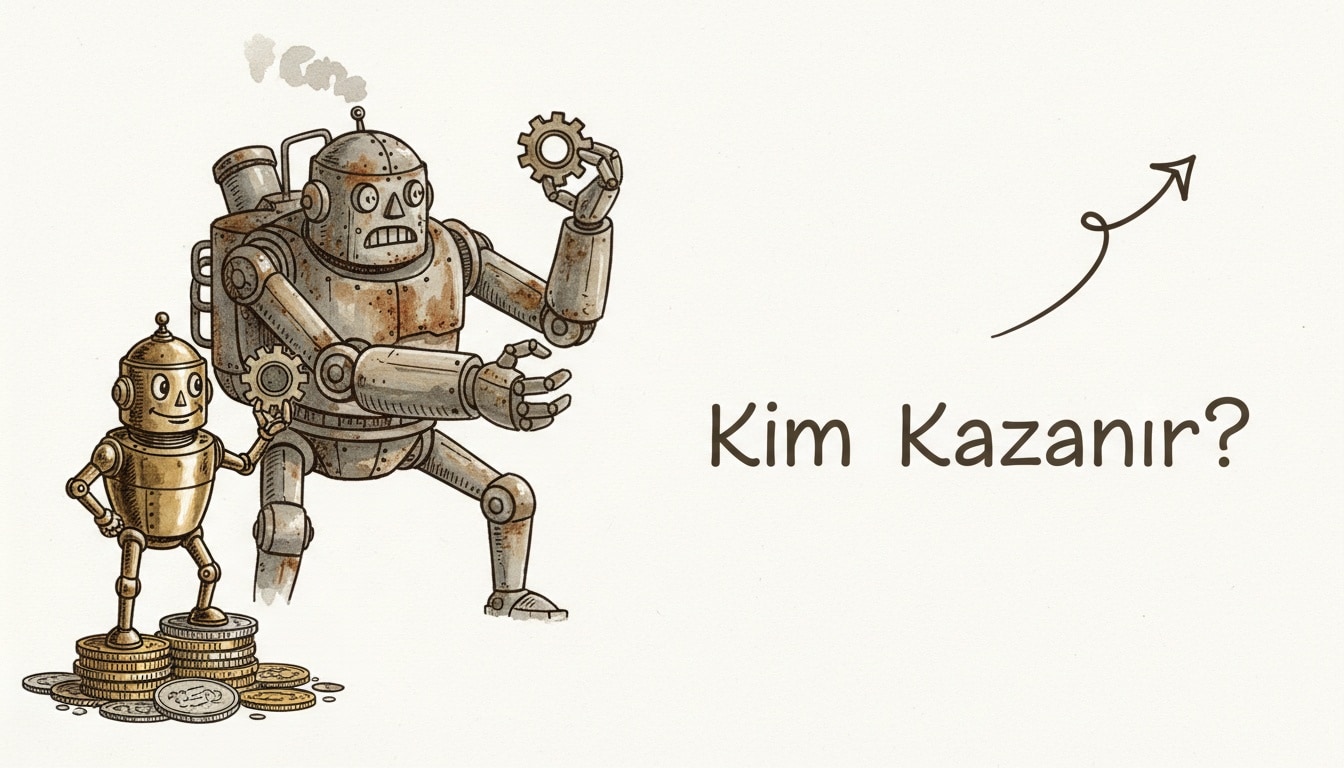
Small language models (SLMs) — ranging from a few million parameters up to roughly 7B — beat frontier models on narrow, high-volume, repeatable tasks: classification, routing, extraction, form-filling, and FAQ answering are the classic wins, where a small model is cheaper, faster, and often more accurate on that specific job. Frontier models remain necessary for broad world knowledge and open-ended, unpredictable reasoning.
Everyone Defaults to the Frontier Model. Why?
The reflex over the last couple of years has been simple: whatever the task, reach for the strongest model and don't think too hard about the token bill. That was a reasonable shortcut during prototyping. But plenty of teams keep the same reflex once traffic scales, and the invoice grows to match. Here's the uncomfortable truth: tagging a support ticket as "refund" versus "exchange," pulling a date and an amount off a form, or answering a repetitive FAQ question doesn't require a frontier model's broad world knowledge. On tasks like these, a small, fine-tuned model frequently matches — or beats — the general-purpose giant, at a fraction of the cost and latency. By July 2026, the gap is large enough that the industry can no longer treat it as a rounding error.
Where the Small Model Wins: Narrow, Repeatable, High-Volume Work
Tasks where SLMs shine share a pattern: predictable input shape, fixed output format, and high repetition count. Classification, intent detection, routing, form-filling, field extraction, sentiment analysis, and FAQ answering are the textbook cases. What they have in common is that success depends on consistent behavior inside a narrow problem space, not on general world knowledge.
NVIDIA's research team makes a similar case in "Small Language Models are the Future of Agentic AI": a large share of the calls inside agentic systems are, in practice, narrow, repetitive "chores" that a small model handles comfortably. The economics have shifted too. In 2023–2024, fine-tuning a 7B model required a dedicated ML team and a serious GPU budget; today, the same job finishes in well under a day and costs low single-digit dollars in compute for many setups. Spheron's 2026 fine-tuning cost report lays out the numbers behind that shift. That changes the calculus when you're deciding between fine-tuning and RAG — cost is no longer the blocker it used to be, and the decision now hinges much more on task fit.
The Numbers: Cost, Latency, Accuracy
The table below summarizes a typical comparison between a fine-tuned SLM and a general-purpose frontier model on a narrow task:
Criterion | Fine-Tuned SLM (~7B) | Frontier LLM |
|---|---|---|
Cost per request | 10–30x lower | Baseline (1x) |
First-token latency | ~10–50ms (edge/on-device) | ~300–2000ms |
Accuracy on narrow task | Usually matches or exceeds | Sufficient but overprovisioned |
Accuracy on open-ended task | Weak, falls outside training data | Strong |
Privacy / data boundary control | High (on-prem/edge feasible) | Provider-dependent |
Deployment complexity | Requires fine-tuning + version management | Single API call |
These cost and latency gaps come from model choice alone — before you even apply the optimization techniques we cover in cutting LLM token costs, like prompt trimming or caching. That savings is already on the table.
For real-time, bounded interactions — live chat, voice, autocomplete, local or edge assistants — latency alone can be the deciding factor: users notice a one- or two-second wait for the first token, not a 20-millisecond one. If you want to run models on your own infrastructure for these cases, our Ollama vs vLLM vs llama.cpp comparison is a practical starting point.
Where the Frontier Model Is Still Necessary
The flip side matters just as much: SLMs don't replace frontier models everywhere. Tasks that require broad world knowledge, have an unpredictable input shape, or genuinely demand open-ended reasoning — interpreting a complex legal document, debating a new architecture decision, running a multi-step research task that can't be planned in advance — still need a frontier model. A small model tends to fail quietly when it hits a question outside its training distribution; a frontier model holds up better under that kind of ambiguity. As we discussed in AI agents vs. workflows, how predictable the task is sits at the center of choosing the right tool here too.
The 2026 Standard Pattern: Routing
Rather than serving every request with one giant model, the pattern that matured in 2026 — and that consulting firms like Capgemini and Wavestone now flag as mainstream in their trend reports — is this: route roughly 80% of incoming requests, the predictable and narrow ones, to a small model, and escalate only the genuinely complex, open-ended 20% to a frontier model. 2026 engineering guides on model routing report bill reductions in the 40–85% range from this approach, without a visible drop in quality.
A simplified routing layer might look like this:
def route_request(request):
    difficulty = estimate_difficulty(request)  # a small fine-tuned classifier

    if difficulty == "narrow" and confidence(request) > 0.85:
        response = small_model.generate(request)
        if passes_quality_check(response):
            return response

    # low confidence, unclear scope, or a failed quality check
    # all escalate to the frontier model
    return frontier_model.generate(request)
The critical detail here is that the escalation decision isn't a one-time classification — it's an ongoing quality check. Building this pattern without measuring the routing layer itself is risky. To see which requests are failing on the small model, you need to bake LLM output evaluation and LLM observability with tracing and evals into your routing layer from day one.
Build vs. Route: A Decision Checklist
Should you move a task to a small model, or build a frontier-model-plus-routing setup? Work through these questions in order:
- Is volume high enough? At a few hundred requests a month, fine-tuning rarely pays for itself; at tens of thousands, it usually does quickly.
- Is the input/output shape fixed? If the format is predictable — a fixed label set, form fields, a stable JSON schema — an SLM is a strong candidate.
- Can you produce labeled or synthetic training data? A few thousand quality examples is usually enough for fine-tuning; if you don't have that data, budget time to generate it first.
- Is latency or privacy a hard constraint? If yes, an SLM or on-device option becomes close to mandatory.
- Does the tail genuinely include open-ended cases? If so, don't fully commit to an SLM without building a separate escalation path to a frontier model for that tail.
- Do you have monitoring and eval infrastructure in place? If not, build that first — your routing quality can't exceed your quality-control quality.
If you answered yes to three or more of these, your next move probably isn't a bigger frontier-model bill — it's fine-tuning a narrow SLM and putting it behind a routing layer.
Frequently Asked Questions
What exactly counts as an SLM, and what parameter range does it cover?
The widely accepted definition covers models from a few million parameters up to roughly 7B, small enough to run with reasonable latency on a single consumer device or a modest server. The upper bound isn't fixed; some sources extend the category up to 10B parameters.
At what request volume does a small model pay for itself?
The exact threshold depends on the workload, but in practice, narrow tasks reaching tens of thousands of monthly requests typically turn fine-tuning and deployment costs into net savings over a frontier-model bill within a few weeks.
Is building a routing layer complicated?
Not at the basic level: a difficulty classifier, a confidence threshold, and a quality check are enough to start. The hard part isn't the setup — it's continuously monitoring which requests fail on the small model and adjusting thresholds accordingly.
Does adopting SLMs make RAG unnecessary?
No, they solve different problems. RAG gives a model access to current or proprietary information, while fine-tuning changes the model's behavior and output consistency. Many production systems use both together, sometimes on different branches of the same routing layer.