@ahmetcantryk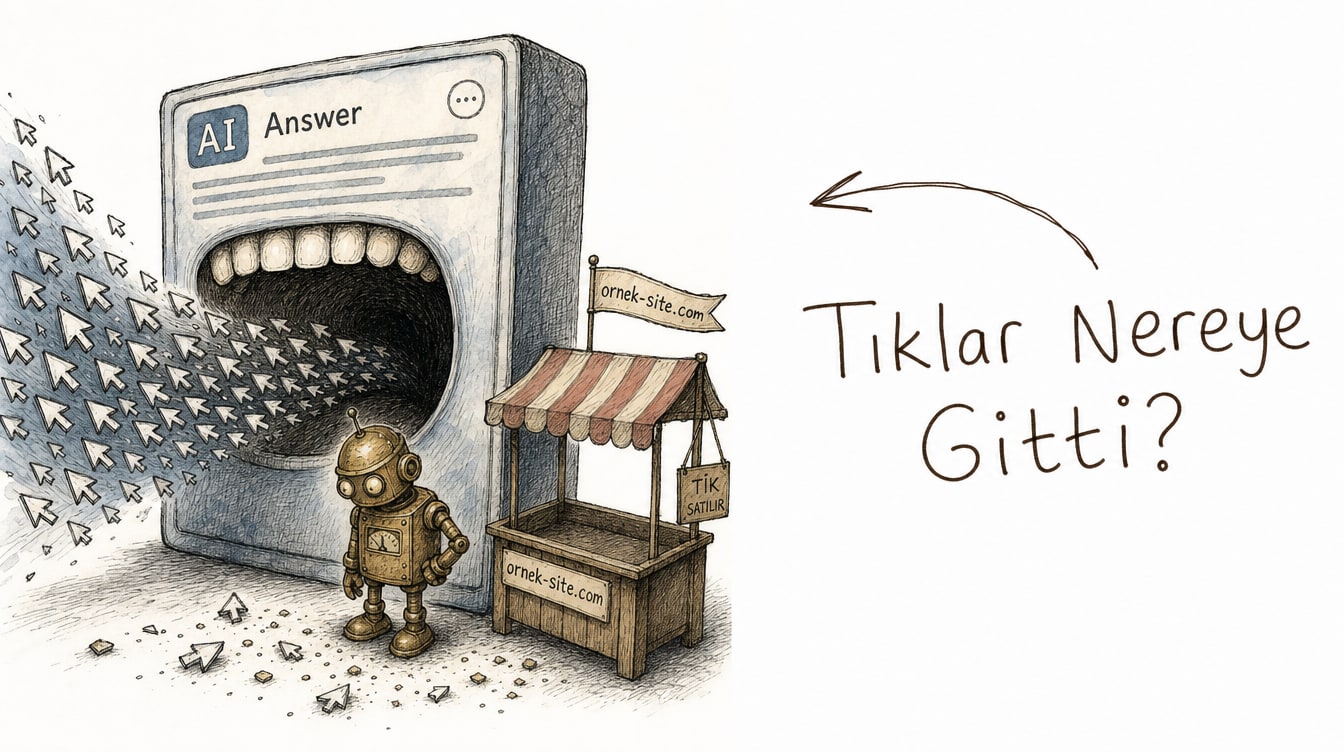
When AI Overviews cut your clicks, the fix is not chasing back the ranking you lost. It is spreading traffic across email, community, brand search, and video, and measuring success by impressions and brand mentions instead of clicks — that is the real defensive playbook as of August 2026. This piece is not about earning citations in AI answers; it is about surviving once clicks structurally decline.
The Numbers: How Big Zero-Click Really Is
SparkToro's June 2026 analysis of Similarweb clickstream data found that 68% of US Google searches now end without a click to any website — up from roughly 60% in 2024. The share of searches that generate at least one click has fallen by about 9.5 percentage points over two years, a drop of nearly 23%.
The real break happens on queries where an AI Overview appears. AI Overviews now show up on more than 20% of Google searches, and when they do, the zero-click rate jumps to 83%, versus around 60% on queries without one. That gap means a single AI-generated summary can cut your click probability nearly in half — because once the answer is already on the results page, there is no remaining reason to visit the source.
Which Content Types Lose Clicks, and Which Still Get Them
The loss is not evenly distributed. Content an AI can fully compress into one paragraph loses the most; content that requires judgment, currency, or interaction still pulls visitors.
Content Type | Click Survival | Why |
|---|---|---|
Definitional / "what is X" | Low | The AI answer states the definition in one line |
Generic how-to guides | Low | Steps get listed directly in the summary |
Static product/price comparisons | Low–medium | Comparison tables get absorbed into the summary |
Live pricing, stock, or real-time data | High | AI cannot guarantee currency, so users click through |
Judgment-based or opinion analysis | High | There is no single correct answer to summarize |
Interactive tools and calculators | High | Cannot be simulated inside a static summary |
Original data and research | High | The AI needs a source to cite — it cannot manufacture it |
The practical takeaway: building content clusters for topical authority is still worthwhile, but its purpose has shifted — it should aim to produce original data and perspective an AI cannot simply copy, not just to rank.
Diversifying Beyond Google Search
If all your traffic depends on Google organic, the growth of AI Overviews is a direct revenue risk. Four channels matter most:
- Owned email. The one channel Google's algorithm changes cannot touch. Our newsletter growth and monetization guide covers building this channel from zero.
- Community presence. Discord servers, niche forums, and Reddit threads generate repeat visitors independent of search ranking. This presence is a relationship, not a one-time visit.
- Brand search volume. When people search your brand name directly, that demand is unaffected by AI summaries and is the clearest signal of real interest. One of the most effective ways to grow this volume is building a founder's personal brand on X.
- YouTube and video. Video results largely sit outside AI Overview coverage and function as their own search engine.
- Referral traffic. Links from other sites bring direct visitors and increase your odds of being cited by AI systems in the first place.
That last point matters for a specific reason: 85% of brand mentions inside AI-generated answers come from third-party and earned-media domains, not the brand's own site. No matter how well you optimize your own pages, where AI systems see you is mostly decided off-site — which makes diversification a requirement, not an option.
Measuring What Matters Differently
As clicks and sessions decline, treating them as your only success metric means missing the signal that is actually still there. Two metrics deserve more weight:
Impressions. Google Search Console impressions show how often your brand appears even without a click. If impressions rise while clicks stay flat, that is not failure — it is the awareness channel doing its job.
Brand mentions inside AI answers. Tracking how often and in what context your brand appears in ChatGPT, Perplexity, and Google AI Overview responses should now be a standard part of SEO reporting. A simple UTM discipline makes channel attribution possible once traffic stops flowing through one funnel:
Email newsletter: ?utm_source=newsletter&utm_medium=email&utm_campaign=weekly-digest
Discord/community: ?utm_source=discord&utm_medium=community&utm_campaign=faq-link
YouTube description: ?utm_source=youtube&utm_medium=video&utm_campaign=video-title
Without that separation, traffic from non-Google channels piles up in an "other" bucket and you lose visibility into which channel is actually growing.
The Mistakes That Make It Worse
Two mistakes turn the zero-click shift from a headwind into a real revenue problem. The first is continuing to publish thin content that adds nothing an AI summary hasn't already covered — it struggles to rank and, even when clicked, gives readers no reason to have bothered. The second is having no owned audience at all: with zero email subscribers, no community presence, and no brand search volume, a single algorithm update can wipe out your entire revenue model overnight.
Here is the opinionated part: chasing individual keyword rankings is now a weaker long-term strategy than building direct access to your own audience. Rankings can reset overnight with the next algorithm or AI summary change; an email list or a community you built cannot.
A 90-Day Diversification Roadmap
Phase | Timeline | Focus |
|---|---|---|
Phase 1 — Measurement | Days 1–20 | Set up impression tracking in Search Console, start monitoring brand mentions in AI answers, apply channel-level UTM tagging |
Phase 2 — Owned Channels | Days 21–50 | Launch an email growth flow, establish a consistent presence in at least one community (Discord or forum) |
Phase 3 — Authority and Video | Days 51–75 | Start a video/YouTube series, build a regular posting rhythm on X for the founder or team |
Phase 4 — Review | Days 76–90 | Compare revenue and engagement across channels, shift budget toward the two channels that grew fastest |
This roadmap does not ignore rankings — it just stops treating them as the only metric that matters. Paired with other posts in our digital marketing category, it covers both the defensive and growth sides of the same problem.
Frequently Asked Questions
Can I stop zero-click traffic loss entirely?
No, and treating that as the goal wastes time. AI Overviews are now a permanent feature of Google search; the objective is not to stop the loss but to make sure revenue does not depend solely on the channel AI summaries are eating into.
Which metrics should go on the dashboard alongside clicks and sessions?
Add Search Console impressions, email list growth rate, brand search volume, and, where possible, the frequency of brand mentions inside AI-generated answers.
How is this different from GEO (generative engine optimization)?
GEO focuses on earning citations inside AI answers. This plan focuses on making sure your revenue survives even when clicks structurally decline — the two approaches complement each other but solve different problems.
Can a small team actually execute this 90-day plan?
Yes. Each phase is sized for a single person to own; running the phases in order without skipping ahead is realistic even for resource-constrained teams.