@ahmetcantryk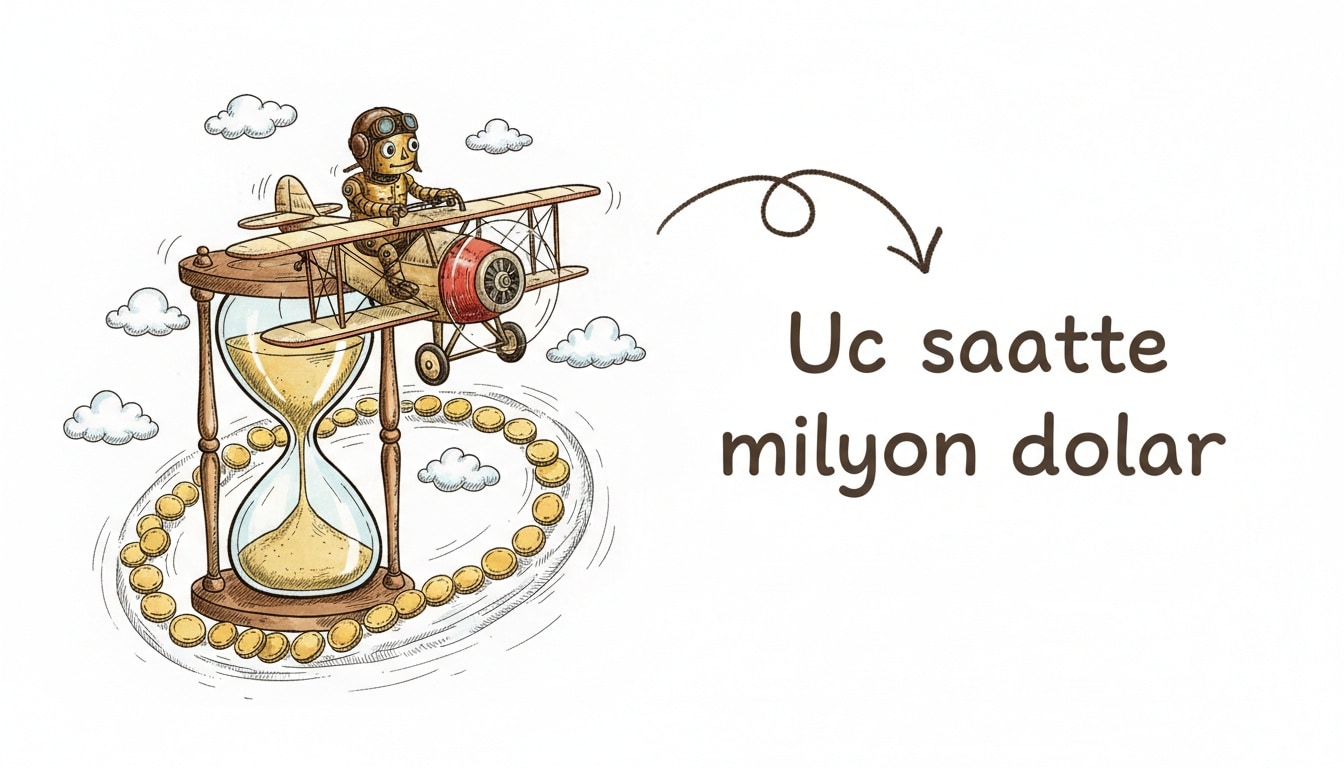
On the morning of February 22, 2025, Pieter Levels, a Dutch developer living in Amsterdam, sat down at his computer and asked himself a simple question: "Can AI actually make a game?" The experiment he started that day would sprint toward a million dollars in annual revenue within weeks, rack up more than 100 million views on X, and become the spark for a whole new movement called "vibe coding." This is a collection of stories about people who sat alone at a keyboard, told an AI "build me this," and actually shipped playable games. No hype, no made-up numbers, all sourced.
A flight simulator in three hours: the Pieter Levels story
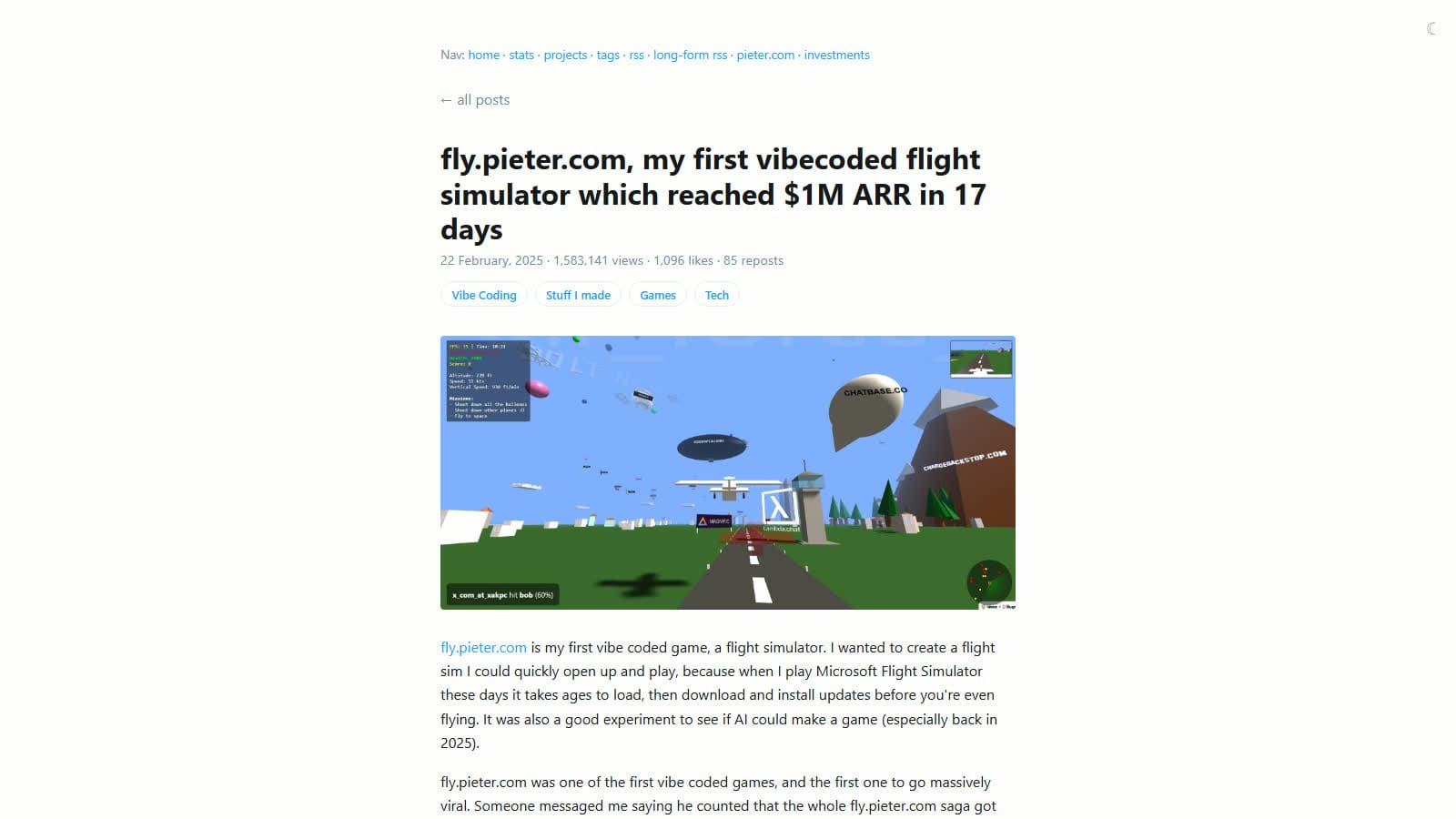
Pieter Levels didn't become famous overnight. He had spent years making a living from one-person startups like Nomad List and Photo AI, known as a "one-man software factory." But he had never tried making a game. He was tired of how long Microsoft Flight Simulator took to open and update; he wanted "something I could start flying the moment it loaded in a browser."
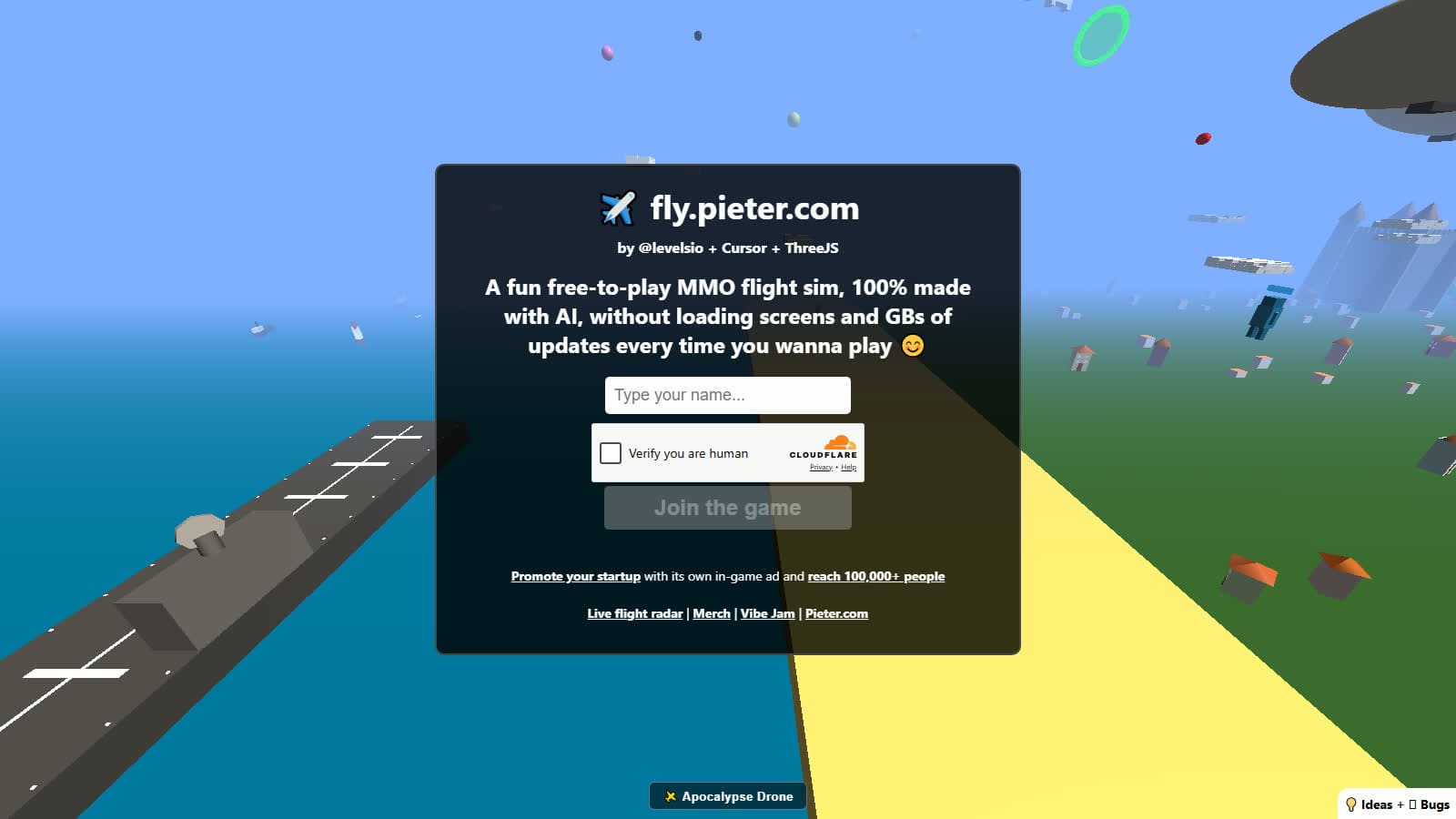
He later wrote up the whole process on his own site. That morning he opened Cursor, an AI-powered code editor, ran Claude and Grok 3 as the models behind it, and used the Three.js library for the 3D layer. He wasn't writing code; he was describing what he wanted in plain English, testing the result in the browser, then saying "fix this, add that." About three hours later he had a rough plane he could fly across the sky. He shared most of the process live on X, and it was exactly that transparency that turned the story into a snowball.
The numbers were genuinely wild
fly.pieter.com quickly grew into a multiplayer browser simulator. By Levels' own account, the project went from zero to $1M ARR in 17 days — roughly $87,000 in monthly revenue. In its first month, 320,000 people flew in the game, with 22,000 to 26,000 players in the sky simultaneously at peak. His posts on X collectively pulled in over 100 million views. A year later the project was still earning somewhere between $70,000 and $138,000 a month — all from a single-person operation.
So where did the money come from? Levels put sponsor ad slots inside the game. Planes with brand logos fly around, giant "billboard planets" hang in the air, and clickable spheres link out to sponsor sites. The biggest buyers were AI startups trying to reach a developer and tech-enthusiast audience. On top of that came in-game purchases, like an F-16 fighter jet for $29.99.
Levels himself repeatedly stressed that this success "came on top of ten years of setup." He built the game in three hours, but building the audience and distribution muscle that could put that game in front of millions had taken a decade. That distinction is the most overlooked, and most important, lesson of the whole story. We dug into whether AI genuinely speeds developers up in our AI productivity paradox article.
Vibe Jam 2025: a gold rush of a thousand developers
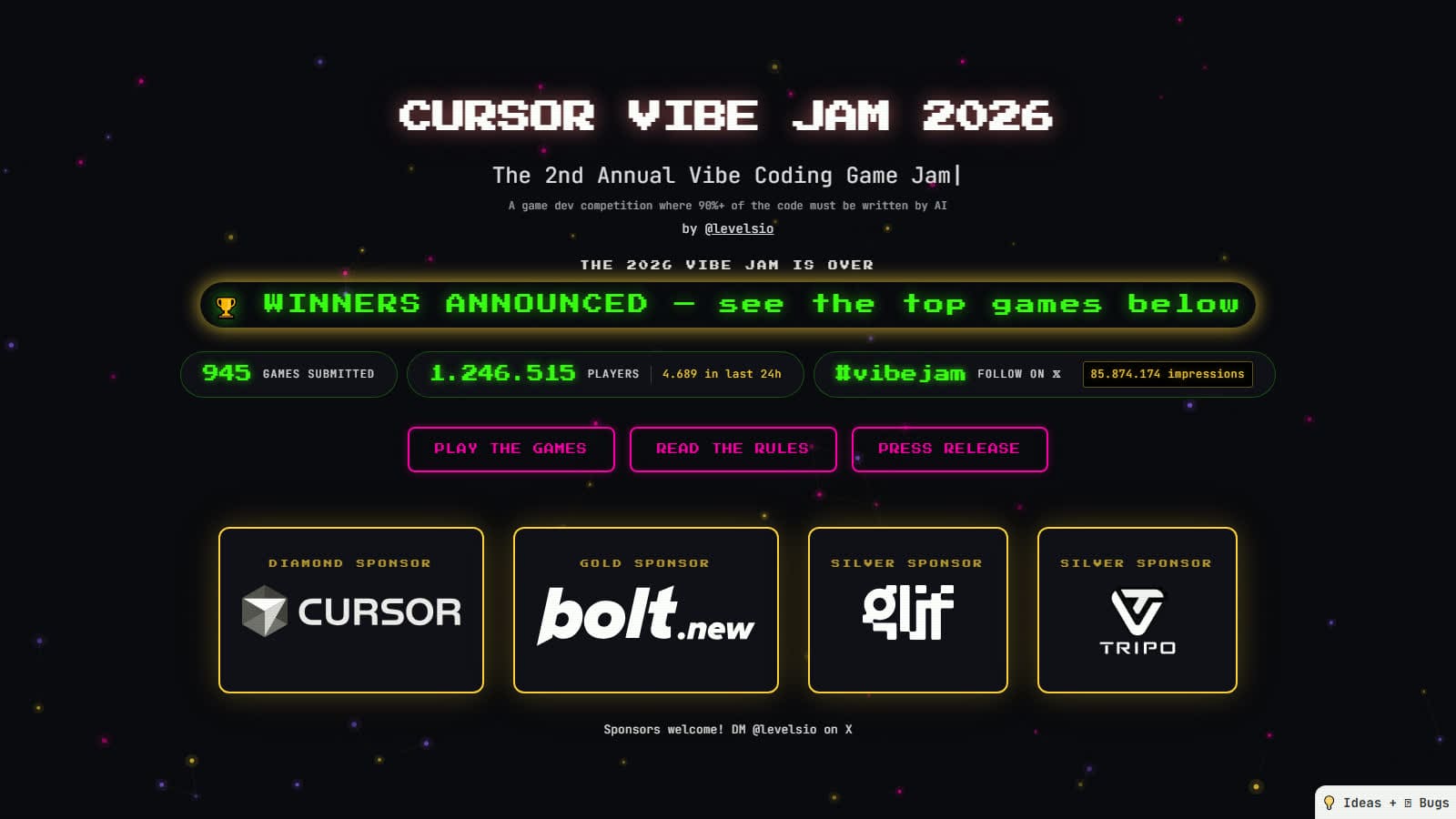
If Levels' story stood alone, it could be dismissed as a lucky exception. But it turned into a movement. At the end of March 2025, Levels launched a competition called the Vibe Coding Game Jam. The rules were simple but radical: at least 80% of the code (90% in the later edition) had to be AI-generated, the game had to run in a browser, no downloads, no login screen, no heavy loading.
The result was staggering. More than 1,170 games were submitted. Entrants ranged from professional engineers to hobbyists who had never written serious code in their lives. Many finished a working game in under 48 hours. This was the first major event to prove that thousands of playable browser games could ship in a single month.
A taxi game took first place
According to the winners announcement, the grand prize went to The Great Taxi Assignment, made by a developer named Tomas Bencko, who won $10,000. In this GTA-flavored game, the player drives a taxi through a busy city, picking up and dropping off quirky passengers, dealing with traffic jams and unexpected events, and using earnings to upgrade the cab's speed and capacity. Second place went to Vibeware by Matt Gordon, a game where you become a bot handed a series of tasks, earning $5,000.
The real message here wasn't the prizes; it was the cultural shift. In one month, more than a thousand people, most without any traditional game development background, put something playable on the internet. The barrier to entry for making games had dropped lower than at any point in history.
Vibe Jam 2026: capybaras and a maturing movement
The story didn't end in 2025. On April 1, 2026, Levels launched the second Vibe Jam, this time sponsored by Cursor and Bolt. The prize pool had grown: $25,000 for first place, $40,000 in cash total. Around 1,000 games were submitted, and this time the judges included various game developers and AI experts.
First place went to "A Game About Capybaras Delivering Food" by a maker named @leocooout, who pocketed $25,000. Second place ("Fanto's Mega-Mart") won $10,000, and third ("WenWare") took $5,000. Comparing the two years, the difference is clear: in 2025 the question was "can AI actually make a game?"; by 2026 it had become "which of these games is more fun and more polished?" The movement had matured.
The reality check: not everyone becomes a millionaire
Now for the less romantic part of the story, because we have to be honest. The headline of 404 Media's article about Levels' game was: "This Game Makes $50,000 a Month. Yours Probably Won't." For all the excitement, that headline is a cold reminder.
Thousands of games were submitted to the Vibe Jams, but only a handful won prizes, and only one reached a million dollars in revenue. On platforms like itch.io, the average indie game still earns somewhere between a few hundred and a few thousand dollars a year. AI made building a game easier, but it did not make getting it noticed, polishing it, and getting it in front of an audience any easier. If you had published the exact same game without Pieter Levels' decade-long following, chances are nobody would have flown.
Another important point: fast-generated code means a maintenance burden down the road. The "I don't care if the code is messy as long as it works" approach is fantastic for a prototype, but as a game grows and real users arrive, that debt comes back with interest. That's why the industry started debating whether "vibe coding is over"; we examined a more disciplined alternative in our spec-driven development guide.
The lessons from these stories
So what should a developer at a keyboard take away from all this? A few clear conclusions:
Speed is no longer an edge, it's the baseline
If you can ship a playable prototype in three hours, there's no point sitting on an idea in your head for months. AI's biggest gift is answering "will this stick?" with an actual experiment in a matter of hours. That's why the best vibe coders focus on fast experimentation and elimination, not on writing the perfect plan.
Distribution is worth more than code
fly.pieter.com's success came largely not from the code but from Levels streaming it live and from his decade-old audience. If nobody sees your game, how good it is doesn't matter. Starting to build your own audience today becomes a multiplier on every future project.
The right tool, the right loop
Successful vibe-coded projects cluster around Cursor for a reason: its file-aware editor behavior and its tight "play, fix, play again" loop are exactly what game development needs. Choosing the right tool directly determines how fast you can iterate. We rounded up the standout tools in our most popular AI tools of 2026 article.
Small and fun beats big and flawless
Look at the winning games: a taxi simulator, food-delivering capybaras. None of them are technical masterpieces. What they share is simple, weird, shareable ideas. In the age of AI, the competitive edge comes less from technical depth and more from a memorable idea.
The best part of these stories is that every one of them began as a weekend experiment. If you're looking for inspiration to start your own, take a look at our AI project ideas to build this weekend. Maybe you'll ship the next viral browser game — or at the very least, have a lot of fun trying.
Frequently Asked Questions
What exactly is vibe coding?
Vibe coding means using an AI assistant as your primary development tool. You describe what you want in plain English, the AI writes the code, and you steer the creative direction. The term was coined by former Tesla and OpenAI engineer Andrej Karpathy in early 2025. The Vibe Jam rules required at least 90% of the code to be AI-generated.
Can you really make a game without knowing how to code?
Partly, yes. Some Vibe Jam entrants were hobbyists who had never written serious code, and they shipped working games. But there's a big gap between "a working prototype" and "a maintainable product millions play." The latter still requires knowledge of architecture, performance, and distribution.
Did fly.pieter.com really make a million dollars?
According to Pieter Levels' own posts, the project reached $1M in annual revenue (about $87,000 a month) in 17 days and kept earning at a high rate for a long time. The main revenue source was in-game sponsor ad slots. The figures are based on the developer's own disclosures.
Can I do the same thing and make money?
Technically, making a game is now very easy, but making money is not. Out of thousands of vibe-coded games, only a handful earned serious revenue. The differentiator is usually not the code itself but the audience, distribution power, and shareability of the idea the developer built beforehand. Starting with realistic expectations is the healthiest approach.