@ahmetcantryk
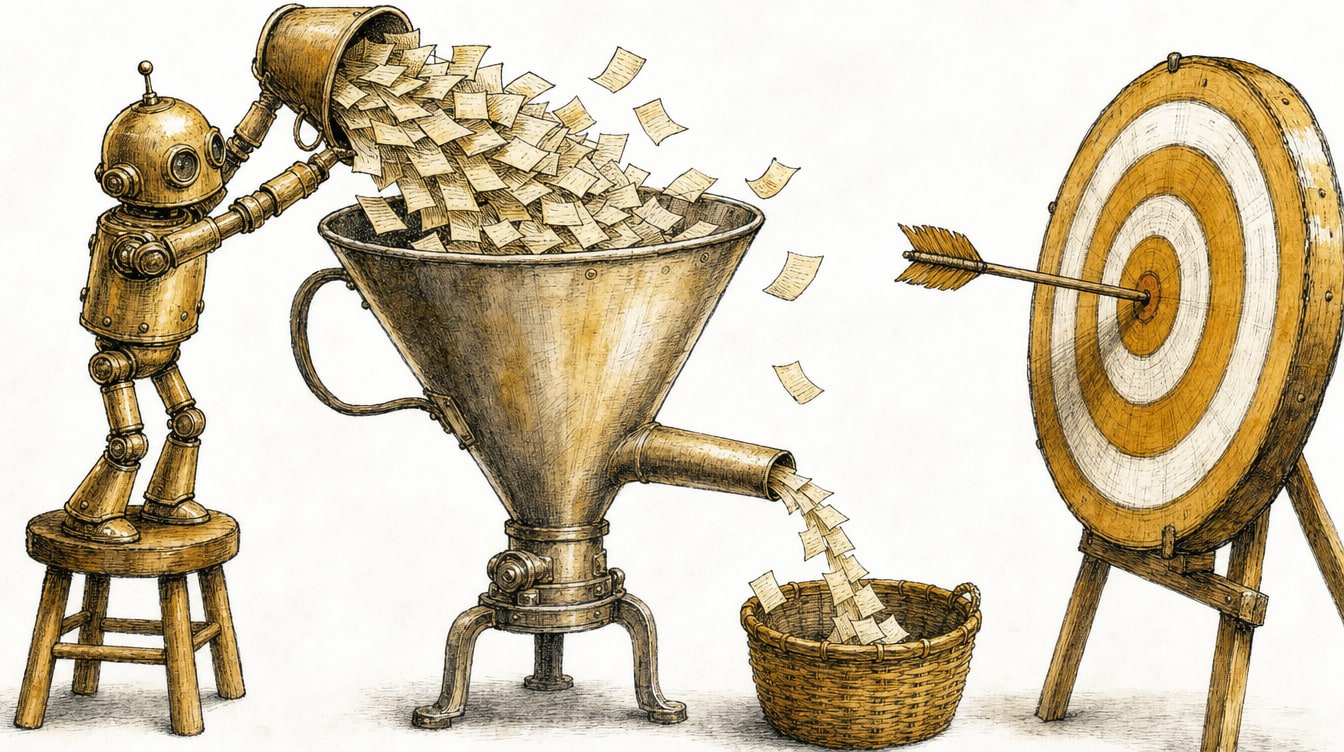
The right way to write a Shopify product description with AI isn't pasting a product name and hitting generate. Feed the model real attributes, benefits, and objections, then run the draft through a human editor — that combination lifts both conversion and citation odds in AI search. Bulk, generic AI copy does the opposite.
Why bulk AI copy hurts conversion and GEO visibility together
Stores that push hundreds of products through a single one-click prompt end up with the same pattern: "high quality," "stylish design," "perfect for any occasion" — adjectives that say nothing specific. That copy gives shoppers no concrete reason to buy, so its contribution to conversion is limited at best. Broader studies on AI content automation report conversion lifts around 10% and revenue increases of 10–12% for high-quality product content, but those numbers depend on quality, not volume — generic bulk copy won't reliably produce them.
The second, less-discussed problem is visibility. As we cover in our guide to generative engine optimization, engines like ChatGPT and Perplexity look for concrete, verifiable, self-contained sentences when deciding what to cite. A thousand product pages that all say "stylish and comfortable" give the engine nothing to latch onto — they're indistinguishable, so none of them get picked. A sentence like "100% cotton, 180 g/m² weight, oversized cut" gives both the shopper and the citation-hungry engine something concrete to grab. Bulk AI copy saves time short-term but quietly erodes sales and AI-search visibility at the same time.
A prompt structure that goes beyond the product name
Feeding the AI only a product name is the most common mistake. Without data, the model fills the gaps with generic adjectives. The winning approach is a structured prompt that feeds it real attributes, the benefit, and likely objections up front.
BAD PROMPT:
"Write a product description for a women's oversized linen shirt."

GOOD PROMPT:
Product: Women's oversized linen shirt
Attributes: 100% linen, 3/4 sleeves, button-front, two chest
pockets, available in beige and khaki, sizes XS–XL
Benefit: breathable fabric for summer, transitions from
office to casual wear
Audience: women 25–40 who want a minimal, low-effort style
Likely objection: "Linen wrinkles easily" — counter with the
fabric's wrinkle-resistant weave
Tone: warm but confident, avoid overused superlatives
Format: 2 short paragraphs + a 4-bullet attribute list
That structure solves three things at once: the copy becomes specific, the objection is handled up front, and because the output is already structured, both editing and the AI-search optimization covered later get easier. A few extra minutes spent on the prompt shortens the editing pass considerably.
Shopify Magic vs. ChatGPT vs. Jasper
Each tool is strongest at a different part of the job — calling one "the best" is misleading.
Criterion | Shopify Magic | ChatGPT | Jasper |
|---|---|---|---|
Cost | Included in Shopify plan | Free tier + paid Plus | Standalone, usually the priciest tier |
Photo-to-copy input | Yes, directly from product photos | No (you can upload and prompt manually) | No |
Brand-voice control | Limited, store-wide basic setting | High, with detailed prompts and custom instructions | Strong, via brand voice profiles |
Shopify integration | Native, inside the product admin | None — copy-paste required | Partial, via Shopify app |
Best use case | Fast, bulk first drafts | Fine-tuning tone and objection handling | Consistent brand voice across a team |
Shopify Magic's biggest advantage is frictionless workflow: it drafts a description in seconds, right inside the product admin, and can pull from the product photo. But its brand-voice control is limited, so it isn't enough on its own for fine-tuning. ChatGPT is the opposite profile: setup takes more effort, but given a detailed prompt like the one above, it's the most flexible for tone and objection handling. Jasper makes sense for mid-to-larger stores that need multiple writers to keep the same brand voice consistent across a catalog — its cost and learning curve are usually overkill for small teams.
The realistic approach isn't picking one of the three, it's combining them by stage: Shopify Magic's photo feature for the first draft, then a detailed prompt in ChatGPT for tone and objection fine-tuning.
Photo-to-spec generation: how AI "reads" a product photo
Shopify Magic's photo-based generation works by analyzing an uploaded product image — reading fabric texture, cut, color, and style cues — and drafting a technical-yet-persuasive description from that analysis (per Stormy AI's 2026 Shopify Magic guide). That's a meaningful upgrade over copy-pasting a generic supplier description, because the output is actually specific to the photo in front of the model.
The catch is that photo quality matters as much as the prompt does. Products listed with professional, branded photography see roughly 12–18% higher add-to-cart rates than those using generic supplier images (per PageFly's Shopify Magic guide). Feed the AI a blurry, low-resolution photo and you get a vague description back — copy and imagery aren't separate jobs here, they're two ends of the same conversion funnel. For tools worth using on the photo side, see our roundup of the best AI image generators for 2026.
A real case makes the relationship concrete: a two-person indie apparel brand used Shopify Magic to generate descriptions for a new collection and saw an 18% lift in conversion rate — attributed not to automation alone, but to better product storytelling. The winning variable wasn't "we used AI," it was "we gave the AI a good photo and the right context."
The actual winning workflow: draft plus human edit
The middle ground between publishing raw AI output untouched and having a human write every description from scratch is, in practice, what actually wins. The loop works like this: AI produces a first draft from a structured prompt or a photo input; a human editor adjusts it to match the brand's real voice, correct sizing charts, and any compliance requirements; the final copy runs through the QA checklist below before it goes live.
What this loop buys you isn't speed, it's consistency. AI left unsupervised risks both factual drift (hallucination) and, over time, flattening every product into the same template. A human writing solo can't cover hundreds of SKUs in reasonable time. Running both together is the product-description version of the approach we outline in our AI content marketing workflow for small teams: AI covers volume, the human protects quality and brand.
Structuring copy so AI search engines can cite it
Product descriptions no longer speak only to shoppers — ChatGPT and Perplexity read them too, and when someone asks "what's the best oversized linen shirt," these engines cite concrete, structured descriptions. Three practical rules follow: every product needs at least one sentence with a measurable, numeric attribute ("180 g/m² weight," not "premium fabric"); claims need specific data behind them instead of vague adjectives ("linen weave reduces sweat in summer heat" instead of "breathable fabric"); and the attribute list (size, material, care instructions) should also exist in a structured form beyond plain prose, because engines pull data out of tables and bullet lists far more reliably than out of paragraphs.
This is a different discipline from classic SEO, but a complementary one. If you want to review how your category pages hold up against the same logic, our digital marketing category has more playbooks along these lines.
Pre-publish QA checklist
- Does the description include at least one measurable, numeric attribute (weight, size, material ratio)?
- Was the objection specified in the prompt actually addressed in the copy?
- Does the color, fabric, and style description match the product photo exactly?
- Does any sentence read like copy-paste filler shared with three other products in the same category?
- Is size, care, and material information also present in a structured list, not just prose?
- Does the tone match the store's real brand voice, or does it read as generic "AI voice"?
- Did a human editor do a final pass, or did this ship straight from AI output?
Frequently Asked Questions
Is it safe to bulk-generate product descriptions with Shopify Magic?
Technically yes, but it isn't advisable. Bulk generation with no context beyond the product name produces generic, near-identical copy across your catalog. A more reliable approach is a structured prompt per product with real attributes, ideally backed by a photo input, with a human editor reviewing the output before publish.
Does AI-written product copy get penalized by Google or ChatGPT?
There's no direct "AI penalty," but low-quality, generic content ranks and gets cited less in both classic search and AI search alike. Engines evaluate whether content is concrete and verifiable, not how it was produced. AI-assisted copy with numeric attributes and specific claims consistently outperforms unedited generic copy.
What can photo-to-copy generation actually read from an image?
Shopify Magic's photo-based generation analyzes fabric texture, cut, color tone, and general style cues, then drafts a description with technical detail from that analysis. Information that isn't visible in the photo — sizing charts, care instructions, exact measurements — still needs to go into the prompt yourself.
How does a small team scale this workflow?
Start with your best-selling or highest-traffic products: generate drafts with a structured prompt and photo input, then run them through human edit and the QA checklist. Turn the prompt template and checklist that worked into a standard, then repeat it across the rest of the catalog. That way volume scales without quality dropping.