@ahmetcantryk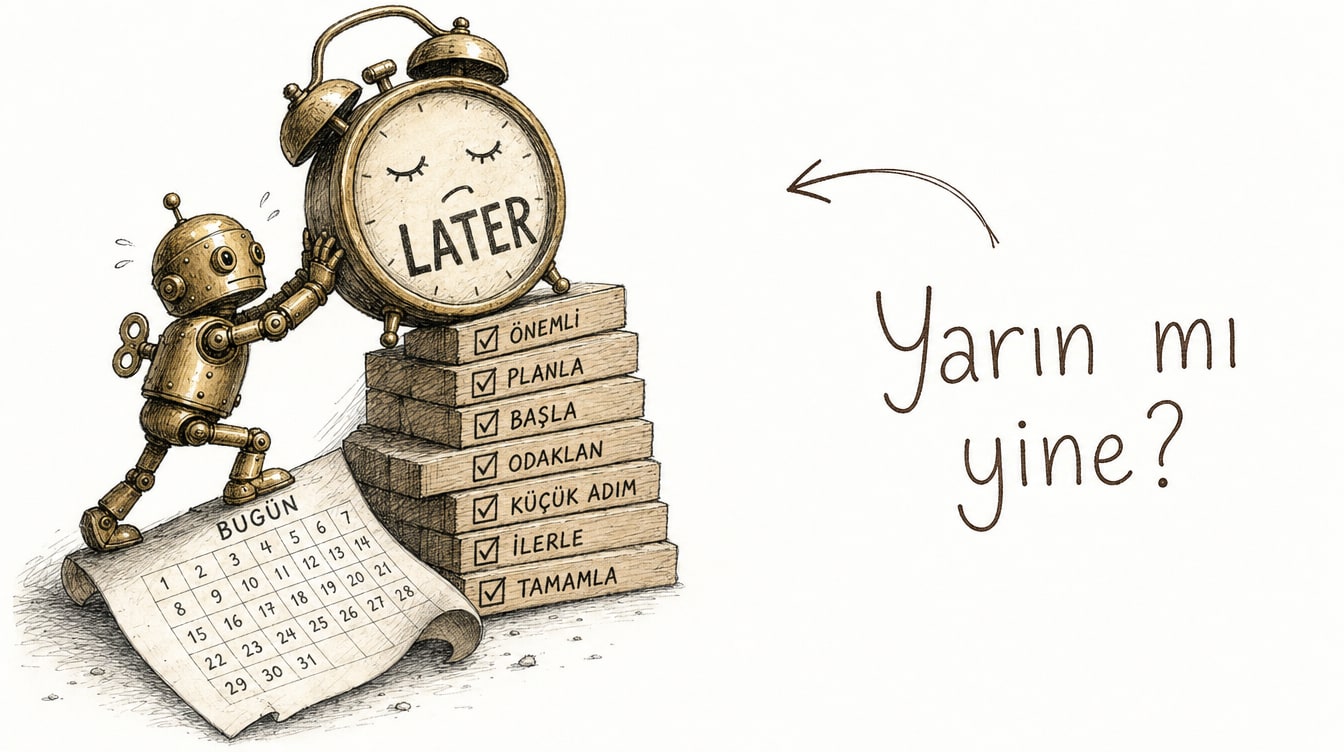
Stop counting how many times you've said "I'll start tomorrow" — the real question is why you keep saying it. Most procrastination advice says "try harder" or "find your motivation." That advice doesn't work, because it's diagnosing the wrong problem.
Why Willpower Doesn't Work
Chasing motivation is itself a form of procrastinating — "I'll start once I feel ready" is just another way of not starting. Researcher Tim Pychyl has spent years making the same point: procrastination isn't a failure of time-management skill, it's a failure of emotion regulation. When we face a task we find unpleasant, anxiety-inducing, or just boring, putting it off delivers immediate relief — our brain codes that as a "good decision" in the moment, ignoring the long-term cost. Psychologist Fuschia Sirois's research lands on the same conclusion: procrastination is an emotion-management mistake made "to feel better right now," not laziness.
Once you accept that frame, it's obvious why "just be more disciplined" doesn't work: the problem isn't a lack of discipline, it's the emotion you're avoiding. Suppressing that emotion doesn't work either — as Sirois points out, accepting the anxiety a task triggers without judging yourself for it works far better than trying to push it down.
Systems That Survive a Bad Week
Motivation fluctuates; systems shouldn't. Here are four approaches that actually hold up:
A ridiculously small first step. Instead of "write the report," set the bar at "open the document and write the title." Your brain avoids big, ambiguous tasks; a two-minute action is easy to clear, and once you've started, continuing is usually easier than never starting at all.
Implementation intentions. Instead of "I'll exercise today," commit to an if-then statement: "At 6 PM, after work, once I've put my gym bag in the car, I'll drive to the gym." That decides the moment in advance. When the time comes, there's no negotiation — the plan is already running.
Friction design. Lengthen the path to the behavior you don't want, shorten the path to the one you do. Put your phone in another room, delete distracting apps, or flip it around — leave the file for the work you want to do open on your desktop. Small differences in friction are far more reliable than willpower.
Time-boxing. Instead of "I'll finish this task," commit to "I'll spend 25 minutes on this." That converts an ambiguously large task into a small, predictable slice of time. When the timer ends, you decide fresh whether to continue — and you usually do, because the hardest part, starting, is already behind you.
What these four have in common: none of them rely on motivation. Even on a bad day, a threshold like "open the document" or "spend 25 minutes" is far more reachable than "feel great about it today."
The Tool Trap: Setting Up Isn't Doing
Worth an honest confession here: downloading a new app, designing a new system, hunting for the "perfect" task manager — all of that can turn into a substitute for actually starting the work. Chasing productivity tools becomes its own form of procrastination, because it feels productive without producing anything. The practical rule: before installing a new tool, try the same system with the simplest thing you already have — paper, a single notes app — for a week. If it works, you didn't need the new tool. If it doesn't, the tool was never the problem.
Developers aren't immune to this trap, either — we touched on it in our piece on avoiding developer burnout: the constant urge to "optimize the system" is sometimes just a refined way of avoiding the actual work.
After a Broken Streak: A Recovery Ritual
Every system breaks eventually — you get sick, a crisis hits, you skip three days in a row. The difference is having a predefined recovery ritual instead of, as perfectionists tend to do, deciding it's "already ruined" and quitting entirely. One simple rule works well: don't try to make up for missed days, just pick back up on the next scheduled day. The urge to "catch up" usually leads to an overloaded, unsustainable day, and the whole cycle starts over.
Old approach | Why it fails | Replace it with |
|---|---|---|
"I'll start once I'm motivated" | Motivation is unreliable and legitimizes avoidance | An if-then plan: fixed time + trigger |
"I'll finish everything today" | Ambiguous size freezes the brain | 25-minute time boxes |
"I need more discipline" | The real cause is emotion, not discipline | Accept the anxiety without judgment, start small |
"I'll make up the missed day" | Overloading restarts the procrastination cycle | Resume where you left off, no catch-up |
Combining Systems With Time Management
These systems don't conflict with general time-management practice — they complement it. If you're figuring out where to fit these four techniques into a packed weekly calendar, see our guide to time management for developers. And if you're questioning whether AI tools actually speed any of this up, our piece on the AI productivity paradox is worth a look — because even an AI tool won't break the procrastination cycle without the right starting system behind it.
A Five-Rule Anti-Procrastination System
- Enter every task through a ridiculously small first step (under two minutes).
- Replace vague intentions with if-then statements.
- Add friction to the unwanted behavior, remove it from the wanted one.
- Break ambiguous tasks into 25-minute time boxes.
- Miss a day? Don't catch up — just resume where you left off.
A Personal Observation: The System Should Disappear
Having tried more productivity methods than I'd like to admit over the years, here's an honest observation: the systems I stuck with longest were the ones I thought about the least. The moment I set up an elaborate app and started tagging, prioritizing, and color-coding every task, the system itself became a new source of procrastination. By contrast, an almost embarrassingly simple habit — writing "today's smallest step" on a single sheet of paper — kept running for months without friction. The less visible a system is, the less willpower it consumes, and willpower was already your scarcest resource to begin with.
Frequently Asked Questions
Isn't procrastination just laziness?
Research says no. Procrastination is an attempt to manage the negative emotion a task triggers, in the moment — an emotion-regulation mistake, not a character flaw.
Does time-boxing work for every task?
It's especially effective for ambiguously sized tasks that are hard to start. For tasks that are already clear and mechanical, like routine email replies, it may not be necessary.
What if I keep procrastinating by building new systems?
That's a sign of the tool trap. Stop designing a new system and stick with the simplest tool you already have for a week — you'll find the problem was never the tool, it was the starting threshold.
Why does the recovery ritual recommend against "catching up"?
Because trying to make up for missed days usually creates an overloaded, unsustainable day, which restarts the procrastination-guilt cycle. Resuming where you left off breaks the cycle faster.